|
This is part two of the discussion between myself and Marie Brennan about wrapping up our four-book series this year. Part one is posted on her blog at http://swan-tower.livejournal.com/491310.html
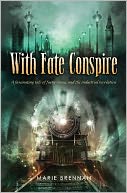
I’m the author of six fantasy novels and more than 30 published short stories, which puts me just a little behind him. I’ve written about people split in half (mystically, not with an axe) and faeries hiding out underneath London, and I’m currently writing about a nineteenth-century gentlewoman who travels around the world to study dragons and get into trouble, not necessarily in that order. I am a mildly popular blogger, and alas, have no fuzzy beasts to take care of — unless you count my husband. She writes a very thoughtful blog at http://swan-tower.livejournal.com. Her latest book is With Fate Conspire, which I reviewed earlier this month. Continue reading Brennan & Hines on Ending a Series (Part 2) Over the weekend, I spent 40 minutes chatting with author Anton Strout for his Once and Future Podcast. Anton has posted our chat in Episode 2 of the podcast, in which we talk about the writing process and also werejaguars (of course), as well as me babbling a bit about my own works. # Or if you prefer, you can head over to Marie Brennan’s blog where she and I talk about ending our respective series, and some of the choices and challenges we faced. Marie is very sharp, and worth reading. I’ll be posting part two of our conversation tomorrow.
Brennan and I both wrapped up a fantasy series this year, and it’s fascinating to see some of the similar choices we made. Much as I did with Snow Queen, Brennan wrote a darker story, raising the stakes for all involved. We both wrote about a formerly good character twisted to dark purposes. In Brennan’s case, that’s Dead Rick, a wonderful character trapped in a horrible situation, his memories torn from him by– Well, I won’t spoil that bit, but I loved the technique used here. Brennan and I are working on a discussion about ending our series and the choices we made. More on that later, assuming I get off my ass and finish my part. (This was supposed to be posted already. It was not, on account of the fact that I suck.) So, back on topic. Oh yes, Dead Rick rocks, and the blending of magic and technology that Brennan began in earlier books has progressed to fascinating ends. I remain in awe of the way Brennan so seamlessly intertwines history and fantasy. She also does a nice job of portraying a society in decline, a magical kingdom on the verge of disintegration. Lune, Queen of the Onyx Court, has vanished, devoting herself to holding the court together through the sheer strength of her will. I missed her character, and I think that loss is a major contributor to the darker tone of this book. Some fairies are searching for a way to escape, while others seek to find a way to heal the court, and the darker fae work to take advantage of the chaos. In the human world, a girl named Eliza has devoted herself to finding her lost sweetheart, stolen by the fairies years ago. But it was Dead Rick and the plight of the fairies that really sucked me into the book. Their desperation, the urgency of their quest to save themselves and their home … it’s powerful stuff. While I think you can read this book on its own, I’d definitely recommend reading them in order. And if you’re a fan of richly detailed and vivid historical settings, full of old-school fairy magic, then I’d definitely recommend reading them, period.
Please welcome Marie, and if you enjoy her post as much as I did, go check out her LiveJournal. Or take a peek at some of her books over on her web page. # Jim has unwisely loaned me his podium for a day while he’s out of town, and since this is the week that The Snow Queen’s Shadow [Amazon | B&N | Mysterious Galaxy] launches, I figure I should talk about fairy tales. I actually have a degree in the subject — nearly had two, before I left graduate school to write full-time. (Yes, they give degrees in folklore.) We studied lots of things, not just fairy tales, but they were always one of my particular interests. So I speak as a semi-expert on the subject when I tell you: I have no idea what the hell these people were thinking. You know how you can tell that “The Snow Queen” is a literary fairy tale, rather than a part of the oral tradition? It makes sense. Evil mirror, shard in the eye, everything looks unpleasant; sure, I follow. But what about these opening lines, to a lesser-known Grimm tale? “There was once a little mouse, a little bird, and a sausage, who formed a partnership. They had set up housekeeping, and had lived for a long time in great harmony together.” Whut? I’m sure Bruno Bettelheim could explain how this story expresses and resolves the oedipal conflicts of children — but that’s because Bettelheim liked to make up data to support his pet theory. Me, I can’t tell you what the heck that’s supposed to mean. If you think fairy tales make sense, that’s because you’re mostly familiar with the ones that have spent two hundred years going through the rock tumbler of the literary tradition, having their nonsensical edges worn off. We heard things in my folklore classes that simply defied all sense. My professor told us one folktale (non-European, but at this late remove I can’t remember where it came from; maybe Swahili, as that was my professor’s specialty) where the heroine spent most of the tale being chased by the demonic severed head of her grandmother, and then when she finally found a way to destroy it, she got cosmically punished for being a bad grand-daughter. (Moral of the story: you owe filial piety even to demonic severed heads?) If “The Snow Queen” had been an oral tale instead of a literary one, Kay’s mind would have been corrupted by a bit of shell under his fingernail or something. Sometimes I think the entire thriving sub-genre of fairy-tale retellings is our collective attempt to wrestle the things into making actual sense. Not just the retellings, either; the Grimms’ Kinder- und Hausmärchen went through seven editions in forty-five years (not counting ten editions of the “children’s version”), and while some of that involved adding and removing tales, there was a heck of a lot of editing going on, too. (Despite Jacob urging collectors to record things “without any cosmetic touch-up or addition.”) They mashed tales together, expanded plots, added Christian elements and tried to scrub out French ones; the 1810 manuscript of “Hansel and Gretel” has the children’s mother sending the kids out to die, before it got changed to a step-mother. Can’t have the story reflecting badly on the flower of German motherhood! It isn’t that there’s no logic to them; folklorists have spent plenty of time analyzing what makes fairy tales go. It’s just that their logic is not our Earth logic. Vladimir Propp laid out a very clear grammar governing the order of events in Russian folktales, and Max Lüthi did an excellent job of describing their aesthetic laws. None of it is much like modern fiction — not even fantasy. Characters in folktales (European ones, at least) don’t bat an eyelash at a talking lion or a mountain made of glass, and if they have to cut off a finger to make a key to open a door, they do it without even saying “ow.” Modern fantasy more often bears a resemblance to the folkloric category of “legend” . . . but that’s a topic for another post. The thing about fairy tales is, they’re like Rorschach ink-blots. What you see in them depends on who’s looking. And that, I think, is why we go on retelling them: we keep seeing with new eyes, finding new things to amplify or argue with. Their very simplicity and persistent weirdness makes them nigh-infinitely flexible — and at the same time, the shared familiarity of the most common tales means your audience is already part of the conversation you want to have. No wonder we keep coming back to them. For the past week or so, most of my brain has been going into trying to write up proposals for a new series. I’ve got the first synopsis written, and my agent says it looks like fun. The second book … well, I scrapped that one and started over yesterday, and I think I’m on the right track. But I find myself skimping a little on the blog as I try to get these finished and submitted. So this seemed like a good time for a book giveaway. I’ve ended up with extra copies of Marie Brennan’s A Star Shall Fall [B&N | Mysterious Galaxy | Amazon] and Tanya Huff’s The Enchantment Emporium [Amazon | Mysterious Galaxy], and I’d love to find good homes for both of them.
To enter, you’re going to have to help me out with this synopsis I’m writing – leave a comment suggesting the weirdest/silliest/most bizarre twist I should add to my new series. Yes, I know I haven’t told you what the series is about. That’s what makes it fun :-) Be as creative as you’d like, and make sure you say which of the two books you’d like to win. One entry per person, and this is open to everyone. I’ll pick two winners at random on 10/20/10. Welcome to First Book Friday, an ongoing series exploring how various authors sold their first books. Marie Brennan’s fifth book, A Star Shall Fall, came out earlier this week. She’s scheduled to be a Guest of Honor at the Sirens Conference next month. Also, she recently invented the iPlatypus. (2 of these 3 facts are true.) She turned 30 on Wednesday. Once you finish reading about her six-year journey from writing Doppelganger to seeing it on the bookstore shelves, go wish her a happy birthday. #
Doppelganger [B&N | Mysterious Galaxy | Amazon] (later republished as Warrior) was mostly written in the summer of 2000, parts of it while on an archaeological dig in southern Wales. (I recall writing a few scenes with my laptop balanced on an air mattress while the wind tried to blow my tent down around me.) Finished in August, cleaned it up, started shopping it around. For those who have never tried it: this is a slow process. I queried at least fifteen agents, maybe more, but the really slow part was publishers; there were still some back then who would consider unagented manuscripts, but I could only submit to them one at a time. My closest call was with Roc; the editor read my query and asked for a partial, read the partial and asked for the full manuscript, read the full manuscript . . . and passed. Altogether, that took about nine months. (I wrote a whole other novel in that time, one I hope to dust off and sell someday.) But I wasn’t as aggressive about querying agents as I should have been, and after a few years I’d run out of publishers who would look at my book without one. In the interim, I’d done something smart: I’d written other books. Three, in fact, not counting the one before Doppelganger. So I kept querying and submitting with new material. But in autumn of 2004, after letting this book gather dust for a year and a half while I debated what to do with it, I decided to try a long shot. I’d heard that sometimes you could send a query letter — no sample, just a letter — to publishers that didn’t take unsolicited submissions; if an editor followed up, then you could sneak in the back door, so to speak. I mailed off three, to Bantam Spectra, Del Rey, and Warner Aspect. Spectra never replied; Del Rey wrote back to say they meant it about not taking unsolicited submissions; Warner Aspect asked for the manuscript. Precisely four weeks later, I got a phone call from the editor. She said she’d shown the book to her boss, and her boss had reminded her that they didn’t buy unagented books. So I should go get myself an agent. With an offer pending, it’s a lot easier to get attention from agents. I contacted two immediately, and hit it off with one, Rachel Vater; I’m still with her today. December 8th, 2004, she called to say she’d hammered out the details of the offer from Warner, and I gave her the go-ahead to accept it. April 2006, it was on the shelves, and it’s been going strong ever since: two editions, enough printings that I’ve stopped counting, three foreign language sales, and it earned out its advance within the first few months. I think of it as the Little Book That Could. (If you’d like to know what happens after you sell your first novel, I’ve got a multi-part essay on my site that follows Doppelganger through the process.) I’m very fortunate. I’ve got a lot of very nifty friends and acquaintances, both the real-world and the online variety, and sometimes I’ve just got to show them off. To that end, I’m declaring this an open “Promote Your Friends” thread. Please feel free to post whatever cool projects or accomplishments your own friends have been up to lately. (If you’re on my jimchines.com blog and your comment doesn’t show up, let me know and I’ll rescue it from moderation.) Let the promo begin!
Finally, my author friends have some new books out.
Your turn. What nifty things have your friends been doing? —
The series takes place in a very richly-described, well-researched London, where the Onyx Court of the faeries coexists beneath the city, magically intertwined with the geography and fate of mortal London. I’ve said in my prior reviews that the first two books have a more leisurely pace in the beginning … but not book three. A Star Shall Fall opens in 1757. The dragon of the second book, which caused the Great Fire of 1666, was banished to Halley’s Comet when its original prison began to fail. In the seventeenth century, nobody knew the comet would be back. Now their only hope to defeat the dragon upon its return is to combine faerie magic and human science… This is my favorite of the series so far. The plotting is sharper, the characters are great, and Brennan continues to blend history and magic so smoothly it’s hard to tell where one ends and the next begins. I love the way she worked 18th century science, everything from alchemy to astronomy, into the story. I loved seeing Lune struggle with her weaknesses, both from the damage to her realm and from the iron wound she received in book two. Those vulnerabilities made me cheer for her even harder. The young and untested Prince of the Stone Galen was a nice addition as well, and it was great to see him develop over the course of the story. I was glad to see Irrith back, rough edges and all. Delphia, Abd al-Rashid, the von das Tickens … they’re all wonderful characters. Even the faerie villain was well-developed, to the point where I almost sympathized with him at times, even when I was hoping he’d take an iron bullet to the heart. (The human villain felt a little flat in comparison, but only a little.) And the ending … well, there’s a reason I showed up exhausted for work last week. Authors are, at their best, simultaneously cruel and beautiful. Well done, Brennan. The book comes out August 31 of this year. Like the others, it’s not an action-packed adventure. But if you’ve read the first two, you have to pick this one up. If you haven’t, A Star Shall Fall stands alone fairly well. You’ll be missing a little backstory, but nothing that should keep you from truly enjoying the book.
As England falls into civil war, Lune must face enemies both from other faerie realms and within her own court. Her enemies attack both the Onyx Court and London above. Intrigue and betrayal and would-be assassins, all leading to the release of a dragon who threatens to burn all of London, and to destroy Lune and her court. The historical detail in these books is … hm. Let me put it this way. Brennan researches the crap out of these novels. You can see her research bibliography, as well as the details of her trips to London, on her web site. That work pays off, resulting in a London that feels real down to every last detail. The first part of the book felt a little slow to me. Brennan takes us through the beginning of the English Civil War and the execution of King Charles (I assume it’s not a spoiler if it happened over three hundred years ago). While the story is interesting, this series is most engaging to me when we see the parallels between the human and faerie realms, and the faerie side felt a bit nebulous in the beginning. (By the end, on the other hand, you couldn’t pry the book out of my hands.) I loved some of the secondary characters in this one: the giant Prigurd Nellt, the faerie knight Sir Cerenel, the doctor John (Jack) Ellin … and of course, the Goodemeades are always wonderful. It’s a fascinating world. The details of the Onyx Court and its magic, the rituals of faerie, the intertwining of human and fae history. The third book, A Star Shall Fall, comes out on August 31 of this year, but I’m fortunate enough to have an ARC waiting for me to dive into Like I said in the review of the first book, if you’re looking for action-heavy page-turning adventure, this might not be the book for you. If you enjoy richer worldbuilding and historical fantasy, I highly recommend the series. And if you’re undecided, head over to Brennan’s site and read an excerpt. If you’ve been reading the series, what did you think?
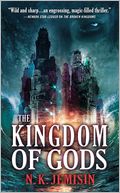
Wow. I’d heard a lot of buzz about this one, which always makes me nervous, because big book buzz doesn’t always translate to a book I’ll enjoy. But I have to say, this is the best book I’ve read so far this year, and as soon as I can remember how, I’ll be recommending it for the Nebula. Was it a perfect book? No book is. But I loved the narrative style, I loved the worldbuilding, I loved the gods and most of the characters. It was a very well-written fantasy that sucked me in and kept me up late for the past two nights to finish it. Jemisin has the first three chapters posted on her web site. Go forth and read. # One of the nice perks of being an author is that you get the occasional ARC or review copy. This has been a good month. Sitting on my To Be Read pile are review copies of:
I love being a writer
What about you? What have you read and enjoyed lately, and what are you looking forward to picking up next? |
||
|
Copyright © 2012 Jim C. Hines - All Rights Reserved |
||