Coming August 6:

Read Chapter One: pdf, epub
[Amazon | B&N | Mysterious Galaxy]

Free Fiction

An Apology to The Write Agenda

The other day, I wrote that my candidacy appeared to have annoyed the folks over at The Write Agenda. They’ve written to explain that no, not only have I not annoyed them, they’re actually pleased with my candidacy, wishing me the best of luck and describing me as “a potential Moses.”

Okay, I admit this was not what I was expecting, and even threw me off-balance a bit. So I went back and checked the comments that referenced my “bad reputation” at TWA.

First of all, I was shocked to discover that, despite having three different names, those comments appeared to have come from the same person! What a shocking twist. And the IP address puts this individual on a computer at Matawan Aberdeen Library–

HOLY CRAP, IT’S ANOTHER TWIST!!! By an incredible coincidence, Matawan also happens to be the home of “literary agent” Barbara Bauer:

Barbara Bauer Literary Agency, Inc.
[Street Address Removed]
Matawan, NJ 07747-2944

Some of you might recall Ms. Bauer from such blog posts as Making Light’s Dumbest of the Twenty Worst, the discussion at Absolute Write, alerts from Writer Beware, and more.

Now, according to a great deal of research by Writer Beware, The Write Agenda appears to be associated with Robert Fletcher and Strategic Book Publishing, a.k.a. Strategic Book Publishing and Rights Agency, along with a number of sockpuppets.

While the Write Agenda seems to have a fairly cozy relationship with Ms. Bauer, it’s also true that The Write Agenda have their own sockpuppets, like “Nick Caruso” and “Lizzy Greenberg” and “Michael Sigvagni.”

Ms. Bauer–or whoever from Mattawan, NJ happened to be posting those comments–seems to have adopted a different approach, using the names of authors and others she feels have wronged her for her sockpuppetry.

I’ve watched enough Criminal Minds to realize what this meant. The signatures didn’t match, and I was accusing the wrong unsub!

Man, do I have egg on my face or what? I MIXED UP THE SOCKPUPPETS! Mea culpa, and I apologize to Robert and everyone else at The Write Agenda for getting their sockpuppets confused with those of Ms. Ba–I mean, the “anonymous” commenter from New Jersey.

2012 Writing Income

Ever since 2007, I’ve been doing my best to talk openly about my income as an author. It’s occasionally awkward, but I also believe it’s helpful to new and aspiring writers. If nothing else, it lets me play Mythbuster with the fairy tale that writers are all fabulously wealthy with their own built-in laser tag arena and fleet of customized DeLoreans…

My income posts from previous years are here: 2007, 2008, 2009, 2010, 2011.

2012 was an odd year. In many ways, it’s the best year I’ve ever had as an author. My eighth book with DAW came out in hardcover, and went through four printings in the first few months. I won a Hugo award. I saw some of my books come out in audio format for the first time ever. The goblin books were re-released as a trade paperback omnibus, and also sold to the Science Fiction Book Club.

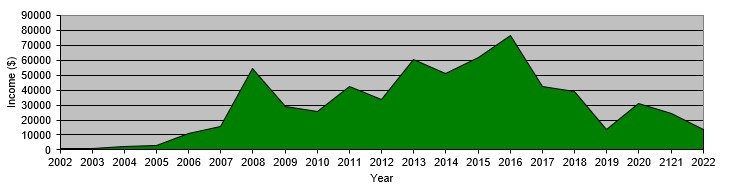
So it was a little weird at first to realize that I made significantly less money in 2012 than I did in the prior year. The grand total for 2012 was $33,598.19 before expenses and taxes and all the rest. Compare that to almost $43,000 from 2011.

I figured the reason for the drop was pretty straightforward: I didn’t sell any new books to my U.S. publisher last year. The deal for Libriomancer and Codex Born was made in 2011, and while I have ideas for book three in the series, I haven’t pitched it yet. So while 2012 saw some money for delivering the final manuscript for Libriomancer and the on-publication payment, it wasn’t as much as the on-signing advance for those two books last year.

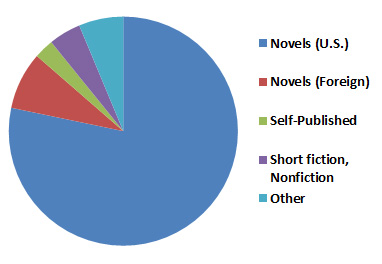
At least, that’s what I had assumed … and then I started looking at the numbers more closely. Thanks to royalties and subrights sales (audio and SFBC), my U.S. novels actually made more than they did last year. Turns out it was the foreign sales that saw the real drop, and I’m not sure why.

The income from my self-published titles jumped a bit, probably in part because I put another collection out midway through the year. I didn’t write or sell much short fiction last year, which is part of why the miscellaneous income (from speaking fees, a few nonfiction pieces, and reprint sales) is the smallest category.

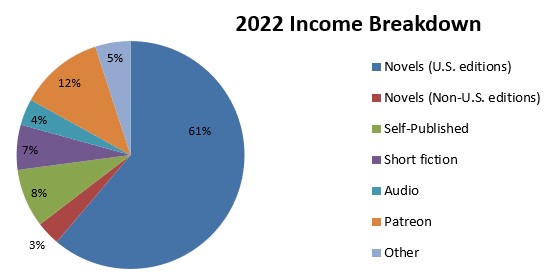
  • Novels (U.S.): $25,800
  • Novels (Foreign): $5,020
  • Self-Published: $1,950
  • Miscellaneous: $820

I’m still sorting out expenses for the year, but it looks like that’s going to come in around $2000 or so, mostly for conventions. That’s been fairly steady for several years now. I actually made it to a few more conventions, and did a little more traveling last year, but several of those were Guest of Honor gigs, which helped balance things out.

The other interesting thing (to me) is how erratic the checks were. I made a total of $115 in the month of January, but February was an awesome month, with more than $6000 showing up in the mail. March and April went the same way. The fact that I have a full time day job means I’ve got a steady income I can count on for most of our day-to-day needs, but if I’m ever able to go full time as a writer, I’m going to have to be a lot more careful about budgeting for the long term.

That was my 2012. Please remember I’m just one author, and you can’t make sweeping generalizations from a sample size of one. But I hope the information is useful, and as always, I’m happy to answer any questions.

In Which Others Worry About the State of my Career

For the writer folks, are you reading Kristine Kathryn Rusch’s blog? She has a great deal of experience in the industry, and her posts are worth reading and thinking about, even if I occasionally disagree. Case in point: last week she wrote about auditing your agent, and shared her personal experience with Unnamed Agent who … well, let’s just say they weren’t terribly diligent about getting her all the money she deserved.

She makes a lot of good points. And while I haven’t seen anything to suggest similar problems with my own agent, it’s good to keep these things in mind, and preferably to be aware of them before rushing into a relationship that will affect your career.

A friend pinged me to let me know my name had come up in the comments, where someone was suggesting I should read the post, because it could help me. Another person referenced something I wrote last year about why I was keeping my agent, thanks.

From there, discussion moved to me working for “slave wages,” and how I was being “screwed out of hundreds of thousands of dollars every year.” Another person said it was sad that I was “so against changing anything about his work relationships.”

Let me start by saying I genuinely appreciate people’s concern for my career and financial well-being.

With that said, there seems to be an assumption in some of the comments that I’m blindly sticking with a system that’s screwing me over, that I haven’t seriously considered or researched other publishing options, and so on. I would like to reassure people that this is not the case. I read my contracts, both U.S. and foreign. I review my royalty checks and statements, and I ask my agent about anything that looks odd. (Often he beats me too it, sending me royalty spreadsheets with a note that he thinks some numbers look off, and he’s following up with the publisher.)

I’ve spoken to a lot of self-published authors, both those who went indie from day one and those who started with commercial publishing and switched over to self-publishing. I’ve self-published three collections and one novel, partly for the additional income, and partly for the experience. As my books revert back to me, I fully intend to self-publish those as well to keep them available.

After looking at the different options and talking to people who have gone down those different paths, I’ve chosen to keep my agent and publisher. I choose to stay with DAW and JABberwocky because I’ve determined that this is what’s best for me and my career at this time. That doesn’t necessarily mean it would be best for you. Everyone’s career is different, and there’s no one right way to do this.

The person who mentioned the hundreds of thousands of dollars I should be making also said they saw my books in kids’ hands as often as Twilight and Hunger Games. Which is awesome anecdotal data, but I’ve seen my sales numbers on Bookscan. I’ve been pretty successful so far, but I’m nowhere near Meyer/Collins levels of success.

At least not yet :-)

My situation is my own. I choose to write part time, and to keep a full time day job. I have several chronic health conditions, a partially disabled wife, and a special needs child. And I live in a country that doesn’t have universal health coverage. I could find an insurance plan on my own, but it would be pricy. Health Care Reform will hopefully create more options, and I’ll revisit my situation as things change. But for now, I do choose to be a bit conservative when it comes to the health and care of myself and my family.

So thank you again for the concern, but I’m doing okay. My latest book hit the Locus Bestseller List, is in its fourth printing, and looks like it will have earned out a five-figure advance in three months. It’s been picked up in Germany and the UK so far, as well as by the Science Fiction Book Club (deals arranged by my agent and my publisher, respectively). My earlier work is still in print, and is being re-released in omnibus (Goblins) and audio (Goblins and Princesses) editions, as well as ongoing foreign deals (Stepsister Scheme just came out in Turkey).

I agree with Rusch that it’s important to go into a business relationship with your eyes open. I know I didn’t always do that when I was starting out, and in some ways, I got very, very lucky. I also agree that not everyone needs an agent, and that there are a lot of scams and pitfalls out there.

But I have done research, and I continue to pay attention to different options and opportunities. I talk to different authors, some more successful, some less. Some commercially published, some self-pubbed. Some with representation, some without. This is my career. I watch what’s happening in the industry, and I take it very seriously.

And I am indeed quite happy with where I’m at right now. Thanks!

2011 Writing Income

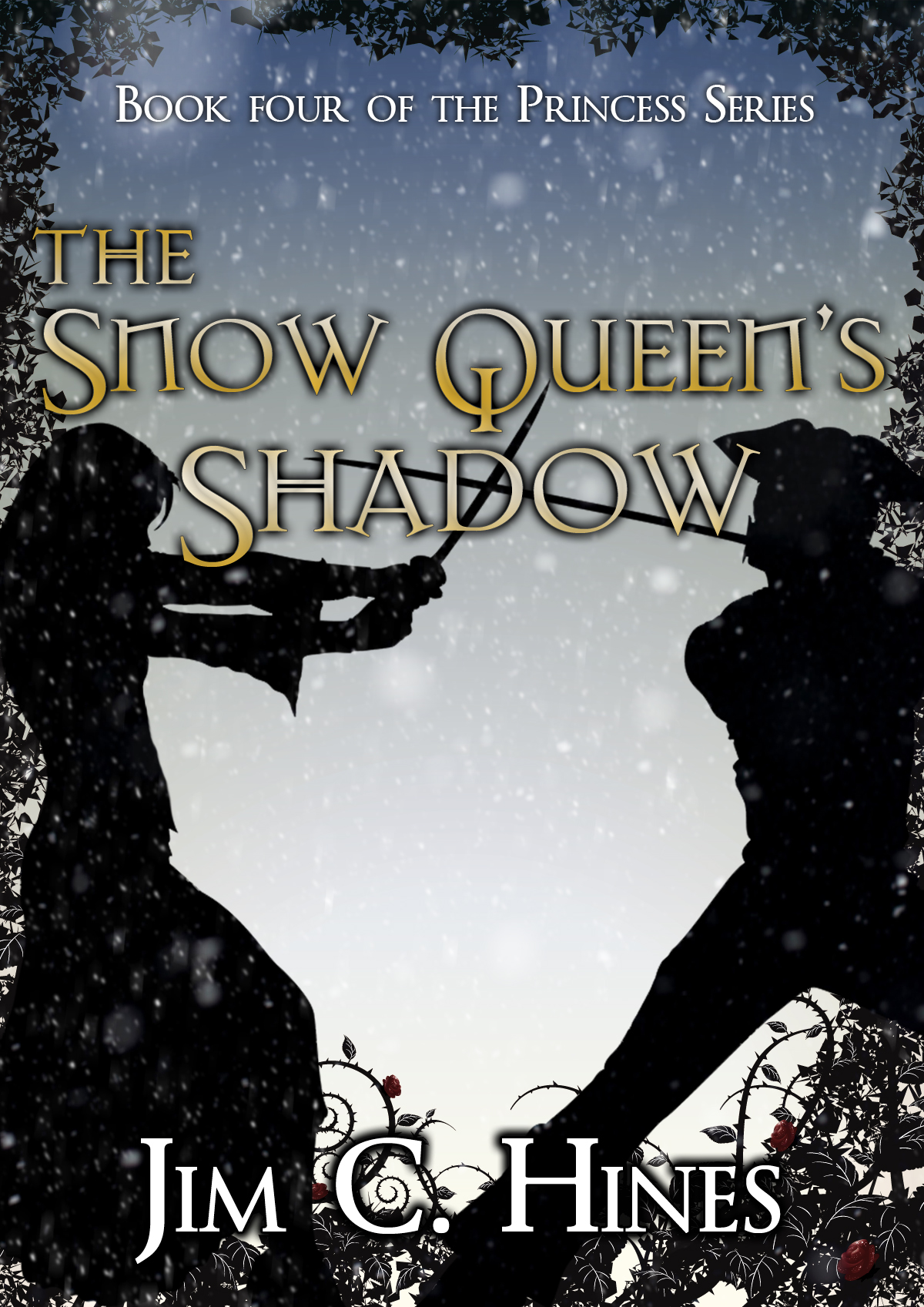
Quick Announcement: I came across the German cover art for Snow Queen’s Shadow yesterday. Click the thumbnail to check that out.

Quick Thanks: My Fantasy Poses post has now been viewed well over 100,000 times, which is awesome. But I’ve noticed that as this continues to spread, I’m seeing a larger number of comments that … well, let’s just say I sometimes take for granted the mostly thoughtful, respectful, and fun comments and discussions from people here on the blog. Glancing at these other sites has been a reminder to 1) STOP READING COMMENTS ON UNMODERATED SITES! and 2) thank everyone here for being generally excellent people.

#

It always feels weird to talk about money. Partly this is because we’re taught not to do so. It also feels uncomfortably like boasting. I know a lot of people are struggling right now, and the last thing I want to do is rub their noses in the fact that I had a good year.

At the same time, there are so many misconceptions about writers and how much they make… I continue to run into people who assume I’m rich because I’ve got some books out, people who expect me to live in a mansion with solid gold robokittens and nuclear powered toothbrushes and so on. And I think it’s important to bust some of the myths about writing and writers.

I’ll put this behind a cut tag. If you’re interested, then read on…

Continue reading 2011 Writing Income

Agents as Publishers

There’s been a fair amount of discussion in writing circles about agents taking on the role of publisher, stepping in to help clients self-publish their work. When I published Goblin Tales [Amazon | B&N | Lulu], I did the majority of the work on my own, but my agent posted it for sale at Kobo and iBooks (taking their usual 15% commission on sales through those outlets).

Joshua and Eddie at JABberwocky have a post about the issue here, wherein Eddie says, “I think the decision to help an author self-publish a book, after failing to place it with a real publisher, is rooted in hubris.

Keep in mind that JABberwocky has e-published several books already. The difference being that JABberwocky is publishing out-of-print backlist titles as opposed to releasing original work. Is that a significant difference? I think so. Does it eliminate any ethical conflicts or problems? That’s a better question.

Joshua asks about the agent’s role in the ever-evolving world of publishing. Personally, I want my agent to do several things for me:

  • Negotiate with publishers on my behalf for the best possible deal.
  • Work on those lovely foreign sales of my work.
  • Help me build a long-term and successful career.

That first point is huge, especially when agents go into self-publishing. If an agent e-publishes a client’s original work, is that really the best possible deal? Personally, if I have a book that doesn’t sell, I’d be tempted to wait a few years and come back to it. For the most part, I’m skeptical that self-publishing an original book through your agent is the best possible deal for the author.

Some of the questions I’m asking as I try to sort out the ethics and potential conflicts of interest for myself…

  • Is the agent charging an up-front fee for self-publishing, or are they working on commission?
  • Is this service limited to clients, or are they offering to self-publish the work of non-clients as well? (The latter suggests they’re moving much more into being a publisher, and I want my agent’s primary focus to be representing clients.)
  • Does the agent threaten former clients with legal action for describing the agency’s “assisted self-publishing initiative” as digital publishing? (Read this one and draw your own conclusions.)
  • Is the agent pressuring clients to use their self-publishing service? (This would push me toward “Run away” mode.)

People have asked, “Why give your agent a cut for something you could do yourself?” But that holds true for agents in general. If you’re savvy enough, you can represent yourself, negotiate your own deals, sell your own work overseas … all it takes is time and expertise.

Some of us don’t have the time. Others lack the expertise. While I enjoyed putting together Goblin Tales and Kitemaster, I want to spend most of my time writing, not publishing. That means hiring someone else to do the work.

There are services out there that will do it for you. Is it better to keep those services entirely separate from agents? Maybe … here are a few things to consider in any case.

  • If the agency is acting as publisher, is there a contract? Who’s negotiating that contract and checking to make sure your interests are protected?
  • What happens if you and your agent part ways?
  • Has the agent demonstrated that they can do this job well? (Being an author doesn’t mean you can typeset or do cover layout or the rest. Neither does being an agent.)

I think it’s an important conversation, and as always, I’d love to hear thoughts and discussion from other folks.

Penguin’s Book Country

Disclaimer: My books are published by DAW, which has a distribution agreement through Penguin.

A few weeks ago, Penguin launched a site called Book Country. From an article in the New York Times, Book Country:

“…will allow writers to post their own work … and receive critiques from other users, who can comment on points like character development, pacing and dialogue.”

So far, so good, right? It sounds like the site was launched with the best of intentions, to help writers improve their craft and learn about the business. But keep reading, and you get to this quote. “Penguin hopes the site will attract agents, editors and publishers scouting for new talent…”

Good luck with that. Writer Beware wrote about manuscript display sites back in 2006.

“They were touted as writers’ Great New Hope: a brand-new cyberspace opportunity to bypass publishers’ closed-door policies and agents’ huge slush piles. Agents and editors, the sites declared, would be eager to visit a venue where manuscripts were pre-sorted into easily-searchable categories and genres, where submissions were pre-screened for quality…”

Repeat after me: there are no shortcuts. Of all the authors I’ve featured on First Book Friday, not one sold their first book via a manuscript display site. It almost makes you think agents and editors already have more submissions and queries than they can handle, and don’t need to spend their free time surfing display sites and hunting the Next Big Thing.

Even Penguin admits their staff won’t be searching the site for new authors. From the FAQ, Book Country “is not a channel for the submission of unsolicited manuscripts to Penguin editors.” Yet discoverability is pushed as a selling point to bring new writers in. “Our members include published authors and industry professionals. You never know who might discover your work.”

You never know who’ll discover your work if you leave your manuscript in a public restroom either. That doesn’t make it a smart strategy.

Book Country does offer critiques from other writers, articles and advice from professionals, and discussion forums, all backed by a major publisher. It costs nothing to join. These are all good things. Former agent Colleen Lindsay has been helping to get Book Country off the ground, which I think adds to their credibility. ETA: Colleen pointed to this link for background on the three full-time employees working on Book Country.

But then you get to the self-publishing angle. From the About Us page, “Later this year, Book Country will offer a convenient and affordable way to self-publish eBooks and print books.”

I’m going to quote a different Writer Beware article from back when Harlequin, another major publisher, started up a self-publishing service.

“I don’t for one teeny tiny second believe that discovering new writers, or giving them a chance to ‘begin their legacies’ or ‘reach the stars,’ plays a major part here. That’s just a marketing pitch. This is about money. Now more than ever, commercial publishers need to shore up their bottom lines–and adding self-publishing divisions is an easy and profitable way to do so.”

Book Country is targeted squarely at writers. Not editors, not agents, and not readers. By itself, this isn’t a bad thing … but publishing is a business, and it’s pretty clear where Penguin hopes to make back their investment.

There’s a lot of good stuff here. I see articles from Supereditor Ellen Datlow, Lou Anders of Pyr, Colleen Lindsay, and more. Online critique groups can be helpful too. If you go in expecting some helpful articles and feedback from other amateur writers, you probably won’t be disappointed.

But don’t go in looking for shortcuts or that big break.

Has anyone here been involved in Book Country? Submitted or critiqued any work, or interacted with folks on the site? Discussion, debate, and more info are welcome, as always.

E-book Updates

Yeah, I know. Jim never posts twice in one day. But I had a lot to babble about, and I’m going to be gone this weekend for Constellation, so figured I’d get the latest e-book data up now.

Let’s start with an update on Goblin Tales [Amazon | B&N | Lulu]. The book came out on March 15, and the March sales were pretty darn good, in my opinion.

Amazon: 130
B&N: 55
Lulu: 20 (18 print and 2 PDF downloads)

The book is also up on iBooks, Kobo, and Wizard’s Tower Bookstore (which will hopefully help international readers). However, I don’t have sales data for these sites yet.

Overall, that’s close to $400 in sixteen days. Nice, eh? Especially for short fiction. So the short term results are looking nice indeed.

The long term? That’s harder to say. April sales for the first week show 20 copies sold at Amazon, 12 at B&N, and 5 at Lulu (4 print, 1 download). Not bad, but a definite dropoff. I’m not going to make any confident predictions here, but it wouldn’t surprise me to see the same sales curve I get with my print books, where there’s an initial spike in sales followed by a dropoff to a lower long-term rate.

Moving on to overall e-book sales, I received my royalty statement from DAW, which had some interesting data. I graphed e-book sales of the goblin trilogy and the first two princess books below. (Red Hood hasn’t been out long enough to generate multiple data points.)

E-book sales jumped in July – December of 2010 for all five books. Even for Goblin Quest, which is a four-year-old book. Not as dramatic an increase for the goblins, but a noticeable one. A number of people have commented on a spike in e-book sales around the end of last year and the start of this one. I’m guessing some of that is due to the holidays, and all of the people who received e-readers and gift cards to spend.

I have no idea if this trend will continue. It would be rather silly to base predictions on a single-period jump. But it’s interesting.

All total, e-book sales make up about 4.3% of total goblin sales and 6.8% of princess sales, but those percentages appear to be increasing over time. For Red Hood’s Revenge [Amazon | B&N | Mysterious Galaxy], which came out in July of 2010, e-books represented 6.7% of total sales.

So there you go. I’m happy to say I’m continuing to earn royalties on all of the goblin books and the first two princess books, and Red Hood should start paying out as well once the reserve against returns goes away.

On Robin Sullivan’s Author Comparison

Several people have e-mailed me about Robin Sullivan’s Midlist Author Comparison, wherein she compares my writing income to that of e-published author David Dalglish.

Tangential disclaimer: back in January, I pointed out some errors in Sullivan’s guest post at J. A. Konrath’s place. She recently responded that the errors were part of Konrath’s introduction, and were his mistakes, not hers. Konrath’s post was edited within 24 hours of my post, but looking at it now, it does appear that the mistakes I pointed out are Konrath’s, not Sullivan’s. My apologies to Sullivan for that.

Sullivan’s new post has its own erroneous details, like “Thomas Buckell’s” survey on advances, or my book “Step Sister Scheme” being book #2 of the Faery Taile Project. But the numbers she gives regarding my writing income look correct. I assume the numbers she cites for Dalglish accurately reflect his self-reported sales as well.

Her conclusions:

  • “Jim’s six books has taken him 4 ½ years and he still is not earning a living wage. His income is impacted substantially by his foreign sales … and without that his income would be dismal …”
  • “David’s six books took 1 year to get to market and while his income initially appeared to be modest within 10 months he has grown to a substantial six-figure income that certainly would classify as a ‘living wage’ … if the current trends for both of these authors continue there will be a significant gap with David outperforming Jim by a substantial margin.”
  • From her post at Absolute Write, “It took Jim 4 years to release six-books and he can’t make a living wage on his writing. David Dalglish has been at it less than a year and gone from making a few thosand a month to making a six-figure income.”

I initially planned to ignore the post. I’m getting more and more bored by the “Indies vs. Traditional” thing. I’ve got a friend whose updates have turned into nothing but advertisements of his own books, retweets of other self-pubbed authors, and slams on commercial publishing. It’s tiresome.

My guess is that people who want to believe Sullivan’s conclusions will do so. But here are some of my thoughts as I read her post… 

  • If Dalglish’s numbers are correct, then he and his books are doing quite well, and I’m happy for him and his success.
  • A comparison of two individuals doesn’t do much from a statistical standpoint (though I recognize the difficulty in gathering larger samples of this sort of thing).
  • Sullivan’s conclusions are based in part on the assumption that both Dalglish and myself are representative of the “midlist.”
  • Her analysis of Dalglish’s data appears to omit a few months.
  • Her projection of Dalglish’s future income assumes his February/March sales rate will continue.

Some of her comments about commercial publishing also jumped out at me:

  • “Typically when published through a traditional publisher a book can take 15 – 18 months to be released and they generally stagger offering from an author at 12 month intervals. For those who write a great deal this can be problematic.” Counterexamples: see Seanan McGuire, Jay Lake, Elizabeth Bear, and many others.
  • “[I]ndustry standards are that only 20% of authors earn out their advances so in many cases the advance is the ONLY money they will see.” More statistics without citations. If she’s correct, doesn’t that imply that 80% of traditionally published authors end up with more money than if they were getting a strict per-book rate?
  • “The traditionally published author will get an advance but it is woefully small … I’ve done a ton of research on this and it really hasn’t changed much over the years but generally ranges from $5,000 – $10,000.” She only cites Buckell’s survey … but that survey appears to contradict her numbers if you read past the section on first novel advances.

Draw your own conclusions.

Harper Collins and the Expiring E-book

From Library Journal: “In the first significant revision to lending terms for ebook circulation, HarperCollins has announced that new titles licensed from library ebook vendors will be able to circulate only 26 times before the license expires.”  The idea is that this matches the average number of times a print book can be checked out before it falls apart and needs to be replaced.

As you might have guessed, this has not gone over well.  There’s the usual cry to boycott the publisher, lots of anger, a Twitter hashtag, and plenty of accusations that HC is stuck in the past and doesn’t understand the future of publishing.

My agent weighs in here: “I’m of mixed emotion on this. I don’t think it’s prima facie a heinous thing to do because businesses do need to adjust to changing business models … On the other hand, it pisses off customers.”

I came across one author suggesting that the idea itself wasn’t necessarily bad, but 26 copies was too few.  I.e., it’s not the principle of the thing, but the numbers.

I’m still thinking about the implications.  I love libraries, both as a reader and an author.  Libraries buy my books, and they allow readers to discover my work.  Realistically, unrestricted e-book lending could decrease the number of my books libraries buy.  If those books never wear out or expire, a library could keep all of my work in circulation forever.  Which would be really, really cool on the one hand … but could also cut into sales, and I like being able to pay my mortgage.

Two things I’m pretty firm on are:

  1. Authors deserve to be paid fairly for their work.  So do publishers and agents.
  2. I like libraries very much, and I don’t want to lose the service they provide to the community.

I keep coming back to the Public Lending Right (PLR) system used in a number of non-U.S. countries.  Basically, PLR is an author’s “legal right to payment from government each time their books are borrowed from public libraries.”  Such a system would eliminate the source of contention, at least from the authors’ perspective.  If I get paid for each checkout of my books, then by all means, keep all of my e-books forever!

I think it would be fair to split such payment with the publisher and agent as well.  And we’re probably not talking about a huge amount of cash here, at least for nonbestselling authors like myself.  But I really like the principle of the thing.

Actually implementing it could be a problem.  Libraries, like many public services, continue to be targeted for massive budget cuts these days.  I asked a librarian friend for her thoughts, and she suggested it would require some sort of tax to cover those PLR payments.  Not likely to happen any time soon, given the current political environment in the U.S.  (If things continue, I imagine a lot of libraries will have to close, which could make the whole thing moot.)

I don’t know the best way to be fair to libraries and their patrons as well as to authors and publishers.  Maybe it would be better to switch to a rental model where libraries pay an annual fee for the right to lend out a certain number of e-book titles from publisher X.  Older books could be removed from the list over time, replaced by newer and more popular releases.

I’m sure there are flaws with that plan, too.  I don’t have the answers.  But I’d love to hear what other folks think, particularly my author and librarian friends.

The Anti-NY Playbook (Bashing Commercial Publishing)

I asked on Twitter a while back why, if e-publishing is so successful, so many self-published e-authors are still promoting themselves by bashing commercial publishing.  Instead of, you know, promoting their writing.

To be clear, I’m not saying that all self-published authors do this.  But there are a number whose public personas spend most of their time going on about how awful commercial publishing is. And I finally figured out why their rhetoric bugs me so much.

It’s because this is the same stuff I’ve been hearing for years … only a decade ago, it was coming almost entirely from scammers and vanity presses.

Take the author who cited Snooki’s book as proof that commercial publishing is imploding.  New York is only interested in celebrity trash!  There’s no room for the truly original, so your best bet is to sign with Publish America e-publish your own work.  (See First Book Friday for a list of non-celebrity authors who sold their books to major publishers in recent years.)

Another e-published author criticized commercial publishing for being too slow.  Why wait two years for your book to come out when Publish America can release it within a week of signing the contract you could self-publish through Amazon and start earning 70% Kindle royalties within 90 days?  (Assuming you don’t care about things like editing, good cover art, pre-publication publicity, and so on.)

But commercial publishers want to rip you off!  Look at these e-published authors who are selling like crazy, getting 70% royalties and making tens of thousands of dollars every month.  It reminds me of the way Paolini used to be “proof” that self-publishing was the way to go.  By the same logic, don’t Rowling and Meyer prove that commercial publishing is the best choice?  Because that way you can become a bajillionaire like them, right?  (Paraphrase: Don’t use outliers to make your arguments.)

Whether it’s the old-school scammers or the new indie author with a grudge, we all know the real enemies are the evil, greedy, clueless editors and agents.  The people who are only in it for the money and wouldn’t know a good story if it hugged their face and planted a book that burst out of their chest a few days later.

The only problem being that this is bullshit.  Most editors love the field, and love discovering new writers and new stories.  The agents love signing new authors and watching their careers take off.  These are jobs that eat up a hell of a lot more than 40 hours a week, and if you’re just in it for the money, then you learn pretty quickly that you chose poorly.

Are there bad editors and agents?  Of course … just like there are lousy [insert any other career here].  What’s your point?

I’m not against e-publishing.  (Heck, I’m about 90% ready to e-publish Goblin Tales.)  I know not all e-published authors are taking this approach to self-promotion and publicity.  But to those who are, well, when so much of your playbook seems to have been swiped from Publish America and their ilk, I hope you’ll understand why I look elsewhere for worthwhile information and conversation.